Dogs do not use words, but they communicate constantly.
They use body posture, facial expressions, tail movement, ear position, eye contact, movement, and vocalizations to communicate comfort, excitement, uncertainty, fear, stress, and other emotional states.
Learning dog body language can help you better understand your dog, recognize when a dog may need more space, and avoid interactions that could become stressful or unsafe.
But reading a dog correctly is not as simple as memorizing a list of signals.
A wagging tail does not always mean a dog is happy. A dog showing its teeth does not automatically mean an attack is about to happen. And a dog rolling onto its back is not necessarily asking for a belly rub.
The most useful approach is to look at the whole dog, the situation, and how the dog’s behavior changes from one moment to the next.
If you are new to reading canine body language, start with one simple question:
Does this dog look loose and comfortable, or tense and uncomfortable?
That distinction can tell you a surprising amount.
Key Takeaways
- Read the entire dog instead of assigning one fixed meaning to one signal.
- Loose, fluid movement generally looks different from rigid or frozen posture.
- A wagging tail indicates arousal or communication, not necessarily friendliness.
- Looking away, lip licking, yawning, crouching, freezing, or trying to escape can be signs of discomfort when they occur in the appropriate context.
- Stiff posture, intense staring, growling, snarling, teeth exposure, or attempts to increase distance should be taken seriously.
- Dogs do not necessarily display warning behaviors in a predictable order.
- If a dog appears uncomfortable, reducing pressure and giving the dog space is usually more appropriate than forcing interaction.
- A sudden, unexplained change in behavior can sometimes be associated with pain, illness, or injury and may warrant veterinary assessment.
The Most Important Rule: Read the Whole Dog
The biggest beginner mistake is trying to translate dog body language like a dictionary.
For example:
Wagging tail = happy
That rule is too simple.
Dogs can wag their tails during excitement, uncertainty, fear, frustration, or social interaction. Tail position, movement, body posture, and the surrounding situation all help provide context.
The same principle applies to ears, eyes, facial expressions, and vocalizations.
Instead of asking:
“What does this tail mean?”
ask:
“What is the entire dog telling me?”
A useful beginner framework is:
Posture → Tail → Ears → Eyes/Face → Movement → Context
You do not need every signal to agree before taking action. If several signs suggest that a dog is uncomfortable, treat that information seriously.
Veterinary behavior guidance similarly emphasizes looking at combinations of behavioral signals and considering the dog’s normal behavior and the context in which the behavior occurs.
Start With Loose vs. Stiff
Before examining individual body parts, look at the dog’s overall muscle tone and movement.
This is one of the easiest ways for a beginner to start reading canine body language.
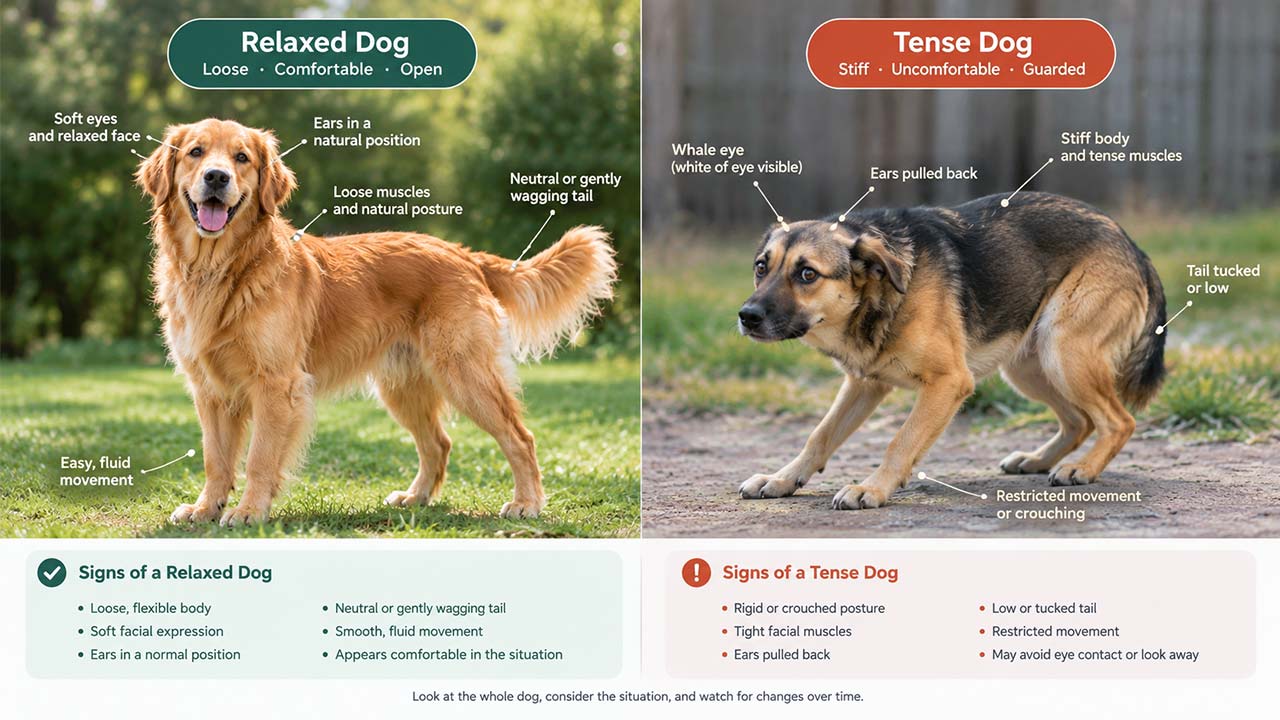
Loose and Fluid
A comfortable dog often appears loose rather than rigid.
You may notice:
- Relaxed muscles
- Natural posture
- Fluid movement
- A flexible body
- Soft facial expression
- Normal, comfortable movement
- Freedom to change position
The dog may be standing, walking, sitting, playing, or lying down.
Relaxation does not require the dog to be motionless.
Stiff and Tense
A dog experiencing fear, conflict, high arousal, or discomfort may become noticeably more rigid.
You may see:
- Stiff legs
- Restricted movement
- Tight facial muscles
- A suddenly closed mouth
- Rigid posture
- Weight shifted toward or away from something
- Freezing
- Intense staring
A stiff posture does not tell you exactly why the dog feels that way.
It does tell you that the situation deserves more attention.
AAHA veterinary behavior guidelines list muscle rigidity and freezing among recognized signs of anxiety or distress, while VCA also describes rigidity, cowering, and changes in posture as possible stress-related behaviors.
The 5 Things to Check First
Once you have looked at the dog’s overall posture, scan the body from head to tail.
1. Body Posture
Start with the dog’s overall body.
A relaxed dog often has a natural posture and moves easily.
A worried or fearful dog may try to make itself smaller.
Possible signs include:
- Lowered head or neck
- Crouching
- Lowered body
- Tail tucked underneath
- Turning away
- Avoidance
- Raised paw
- Attempts to retreat
A dog experiencing high arousal or responding defensively may instead appear more rigid or hold its weight differently.
Watch for:
- Stiff legs
- Rigid muscles
- Raised neck
- Forward weight shift
- Restricted movement
- Sudden freezing
The important point is not that one posture has one universal meaning.
Look for changes from the dog’s normal behavior and combinations of signals.
2. Tail
The tail is useful, but it is one of the most commonly misunderstood parts of dog body language.
Pay attention to:
- Position
- Speed
- Movement pattern
- Tension
- Height
- What the rest of the body is doing
A loose, broad wag combined with a relaxed body can occur during friendly engagement.
A low or tucked tail can occur with fear, uncertainty, or discomfort.
A high, stiff tail can accompany increased arousal or alertness.
And yes, a dog can wag its tail while feeling uncomfortable.
Why Wagging Does Not Always Mean Happy
Imagine two dogs.
Dog A:
- Tail moving broadly
- Loose body
- Relaxed face
- Fluid movement
- Voluntary approach
Dog B:
- Tail held low
- Crouched body
- Ears pulled back
- Avoiding interaction
- Rapid tail movement
Both dogs are wagging.
Their overall body language is very different.
The lesson is simple:
Do not interpret the wag without looking at the rest of the dog.
3. Ears
Ear position can provide useful information, but it must be interpreted alongside breed and individual anatomy.
A relaxed dog may hold its ears in its normal position.
A fearful or uncomfortable dog may pull its ears backward.
An alert dog may hold its ears more forward.
But floppy ears, cropped ears, breed structure, age, and individual differences can affect what these positions look like.
So don’t decide what a dog feels based on its ears alone.
4. Eyes and Face
The eyes can provide another important clue.
A relaxed dog may have soft-looking eyes and little facial tension.
A worried dog may:
- Look away
- Turn its head away
- Avoid direct eye contact
- Shift its gaze repeatedly
- Show more of the whites of its eyes
The visible whites of the eyes are sometimes called “whale eye.”
In the right context, increased visibility of the sclera can occur alongside discomfort, anxiety, or heightened arousal. It should not be treated as a standalone diagnosis of a dog’s emotional state.
A hard, intense stare accompanied by a stiff body is different from a relaxed dog simply looking at something.
Again, context matters.
Facial Tension
Also pay attention to the mouth.
A relaxed dog may have:
- A loose jaw
- A slightly open mouth
- A relaxed tongue
- Soft facial muscles
A sudden change to:
- Tight lips
- Closed mouth
- Wrinkled muzzle
- Teeth exposure
may indicate increasing tension when combined with other body-language changes.
VCA describes changes in the eyes, ears, mouth, yawning, and lip licking as potentially useful clues when interpreted in context.
5. Movement
Movement often reveals whether the dog is comfortable.
A relaxed dog may move smoothly and naturally.
A stressed dog may become unusually still or unusually active.
Possible signs of discomfort include:
- Freezing
- Pacing
- Fidgeting
- Hiding
- Attempting to escape
- Turning away
- Repeated lip licking
- Yawning
These behaviors do not automatically mean stress.
Dogs yawn when tired, lick their noses for ordinary reasons, and sometimes look away without being uncomfortable.
The useful question is:
Did this behavior appear in a situation where the dog also looked uncomfortable?
AAHA and VCA both list behaviors such as yawning, lip licking, freezing, pacing, hiding, escape attempts, lowered posture, and turning away among possible signs of anxiety or distress.
What Relaxed Dog Body Language Looks Like
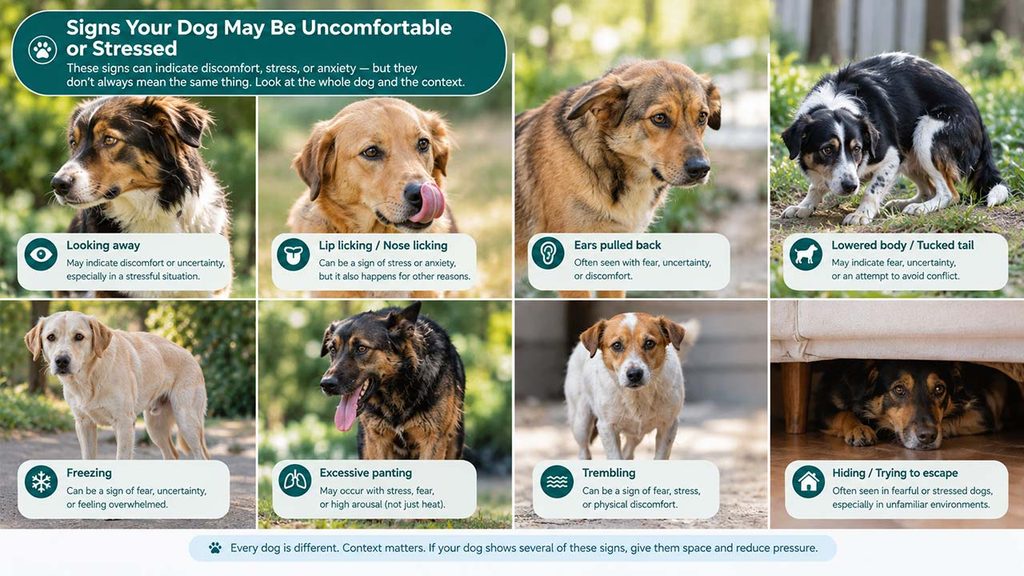
A relaxed dog generally looks loose rather than rigid.
You may see:
- Natural body position
- Relaxed muscles
- Normal ear position
- Soft facial expression
- Neutral or naturally carried tail
- Easy movement
- Willingness to change position
- Freedom to move away
A comfortable dog does not have to be actively seeking interaction.
Sometimes one of the clearest signs of comfort is simply that the dog can move normally and make choices without appearing pressured.
Compare:
Relaxed: loose muscles, natural posture, fluid movement.
Tense: rigid muscles, restricted movement, fixed posture.
This distinction is often more useful to beginners than memorizing dozens of isolated signals.
Signs Your Dog May Be Uncomfortable or Stressed
Dogs do not always begin with dramatic behavior when something bothers them.
Early signs can be subtle.
Possible indicators include:
- Looking away
- Turning the head away
- Lowering the head or neck
- Lip licking
- Nose licking
- Yawning
- Pacing
- Freezing
- Hiding
- Trying to escape
- Trembling
- Excessive panting
- Tucked tail
- Ears pulled backward
- Crouching
None of these behaviors proves that a dog is stressed on its own.
A yawn after waking from a nap is different from repeated yawning while a dog is being restrained and avoiding eye contact.
The more useful pattern is:
Signal + situation + other body changes
Watch for Changes Over Time
Suppose you are petting a dog.
At first, the dog stands normally.
Then it turns its head away.
You continue.
The dog licks its lips.
You continue.
The dog becomes still and stops moving.
The progression is more informative than any one behavior.
The dog may be becoming increasingly uncomfortable.
A sensible response is to:
Stop touching the dog and give it space.
Respecting avoidance rather than forcing interaction is also consistent with veterinary behavior guidance for stressed dogs.
Fear Can Look Quiet
Fear does not always look dramatic.
A fearful dog may try to make itself smaller through:
- Crouching
- Lowering the head
- Lowering the body
- Tucking the tail
- Pulling the ears back
- Avoiding eye contact
- Turning away
- Hiding
- Attempting to flee
Some dogs freeze rather than run.
Others may become defensive if they believe they cannot escape.
VCA specifically lists pacing, fidgeting, freezing, hiding, fleeing, lowered body posture, tucked tails, pinned ears, lip licking, and yawning among possible fear-related behaviors.
This is why a dog sitting extremely still should not automatically be assumed to be calm.
Sometimes stillness means:
“I don’t know what to do, and I am overwhelmed.”
Excitement Is Not the Same as Relaxation
Dogs can become highly aroused for positive reasons.
For example:
- Seeing their owner return home
- Preparing for a walk
- Playing
- Seeing another dog
- Anticipating food
Excitement may produce:
- Rapid movement
- Jumping
- Vocalization
- Panting
- Fast tail movement
But arousal itself does not tell you whether the dog is comfortable.
A dog can be highly excited and friendly.
A dog can also be highly aroused because it is frustrated, fearful, or threatened.
So avoid treating “excited” and “comfortable” as synonyms.
Similar Dog Behaviors That Are Easy to Misread
Some dog behaviors look similar on the surface but can have very different meanings.
Play Bow vs. Defensive Crouch
Play bow
A dog may:
- Lower the front legs
- Keep the rear end elevated
- Move in a loose, bouncy way
- Maintain a relaxed facial expression
- Shift weight fluidly
Defensive crouch
A dog may:
- Lower the entire body
- Shift weight backward
- Tuck the tail
- Pull the ears back
- Become rigid
- Attempt to retreat
The key difference is not simply “low body.”
Look at the hindquarters, muscle tension, movement, and willingness to interact.
Friendly Wag vs. Tense Wag
More relaxed wag
- Broad movement
- Loose hips
- Natural tail carriage
- Flexible body
- Relaxed expression
More tense wag
- High or tightly controlled tail
- Small, rapid movements
- Rigid body
- Forward or backward weight shift
- Intense focus
Avoid rules such as “high wag equals aggression.” Tail height and movement need to be interpreted alongside posture and context.
Relaxed Belly Rub vs. Fearful Roll
Some dogs roll onto their backs because they enjoy belly rubs.
Others may roll over as part of an appeasement or fearful response.
More relaxed
- Loose muscles
- Floppy limbs
- Soft expression
- Comfortable movement
- Voluntary engagement
More uncomfortable
- Rigid body
- Tucked tail
- Tight mouth
- Head turned away
- Avoidance
- Little movement
Before touching a dog that rolls onto its back, look at the rest of its body.
VCA describes avoidance of direct eye contact, lowered posture, ears back, low or tucked tail, yawning, and nose licking as possible appeasement or stress-related signals.
Relaxed Stillness vs. Freezing
A dog can be still while perfectly comfortable.
The important question is whether the stillness is normal and relaxed or sudden and tense.
A dog that suddenly freezes during petting, handling, restraint, or an unfamiliar interaction deserves more space.
What Growling and Teeth Showing Can Tell You
Growling is communication.
It should not automatically be interpreted as proof that a dog is “bad” or that a bite is inevitable.
Dogs may growl during situations involving:
- Fear
- Conflict
- Guarding
- Frustration
- High arousal
- Unwanted handling
The surrounding body language helps provide context.
A growl should therefore be treated as information.
If a dog growls while you are approaching, touching, restraining, or taking something away, stop and reassess the situation rather than simply punishing the growl.
Similarly, teeth exposure can occur as part of a threat or warning display, particularly when accompanied by:
- Stiff posture
- Facial tension
- Intense staring
- Growling
- Attempts to increase distance
The safest practical response is to stop escalating the interaction and create space.
Why Punishing Warning Signals Can Be a Problem
A dog that growls is communicating that something about the situation is uncomfortable, threatening, frustrating, or otherwise significant.
Punishing the warning does not necessarily remove the underlying emotion or situation.
It may also make future communication harder to interpret.
For that reason, avoid treating growling simply as disobedience.
Instead ask:
What caused the dog to feel the need to growl?
Was someone:
- Taking away food?
- Reaching toward a resting dog?
- Restraining the dog?
- Approaching too quickly?
- Entering the dog’s space?
- Interacting with another animal nearby?
Understanding the trigger can help you manage the situation more safely.
AAHA’s behavior-management guidance recommends avoiding punitive approaches and emphasizes recognizing body language and early behavioral indicators.
How Stress Can Escalate
Dogs do not all display discomfort in the same order, and there is no universal sequence that every dog follows.
However, uncomfortable interactions can sometimes progress from subtle signals to more obvious warnings.
A simplified pattern may look like:
Early discomfort → avoidance → increased tension → warning behavior → possible escalation
Early signs may include:
- Lip licking
- Yawning
- Looking away
- Turning the head
- Increased blinking
- Lowered posture
More obvious signs may include:
- Freezing
- Stiffening
- Hard staring
- Raised hackles
- Growling
- Snarling
- Air snapping
- Lunging
In some situations, a bite can occur.
But not every dog shows all of these signals, and some dogs may escalate more quickly or communicate in subtler ways.
Recent veterinary discussion of reactive dogs also emphasizes that the intensity or loudness of a reaction alone does not provide a complete assessment of risk.
The practical lesson is more important than memorizing a ladder:
Do not wait for a growl or snap before giving a dog space.
If early signals suggest discomfort, reducing pressure may help prevent the situation from becoming more intense.
What to Do When a Dog Looks Uncomfortable
When you notice several signs of discomfort or increasing tension, focus on reducing pressure.
1. Create Distance
Move yourself or the dog farther from the trigger when it is safe to do so.
Distance can reduce pressure without requiring the dog to remain close to the trigger.
2. Stop Direct Pressure
Avoid:
- Leaning over the dog
- Reaching toward its face
- Staring directly at it
- Continuing to pet it
- Blocking its movement
Turn your body slightly away and give the dog room.
3. Give the Dog a Choice
Allow the dog to move away whenever possible.
A dog that can retreat has more opportunity to reduce its own stress without needing stronger warning behavior.
4. Reduce Environmental Pressure
Depending on the situation, this might mean:
- Reducing noise
- Moving children away
- Separating dogs
- Removing a source of conflict
- Giving the dog a quiet area
- Ending the interaction
The goal is not to “win” the interaction.
The goal is to prevent discomfort from escalating.
VCA recommends removing a stressed dog from the stressor and allowing it time to regroup in a quieter environment.
What Not to Do
Do Not Punish Growling
A growl is information about the dog’s current state.
Address the situation that produced it instead of focusing only on suppressing the sound.
Do Not Force Interaction
Avoid forcing a fearful or uncomfortable dog to interact with:
- Children
- Strangers
- Other dogs
- Unfamiliar environments
Give the dog an opportunity to create distance.
Do Not Hug or Loom Over an Unfamiliar Dog
Some dogs tolerate hugging, but that does not mean every dog enjoys it.
Wrapping your arms around a dog or leaning over it can restrict its ability to move away and may increase discomfort.
Do Not Test the Dog
If you think a dog may be uncomfortable, do not deliberately continue the interaction to see “how far it will go.”
Respect the warning signs you already have.
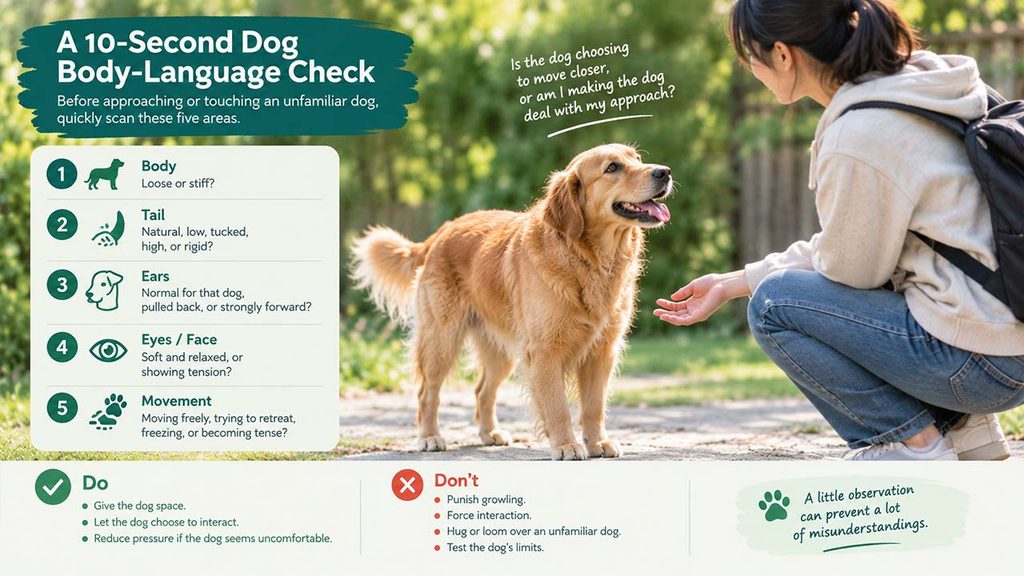
A Simple 10-Second Dog Body-Language Check
Before approaching or touching an unfamiliar dog, quickly scan five areas.
1. Body
Loose or stiff?
2. Tail
Natural, low, tucked, high, or rigid?
3. Ears
Normal for that dog, pulled back, or strongly forward?
4. Face
Soft eyes and relaxed mouth, or visible tension?
5. Movement
Moving freely, trying to retreat, freezing, or becoming increasingly tense?
Then ask one final question:
Is the dog choosing to move closer, or am I making the dog deal with my approach?
That question is particularly useful with unfamiliar dogs.
A dog that voluntarily approaches with a loose body is giving you different information from a dog that remains still while you move into its space.
Why Dogs Lick Their Lips or Yawn
Lip licking and yawning are often described as stress signals, but they should not automatically be treated that way.
Dogs yawn when tired.
Dogs lick their noses for ordinary reasons.
These behaviors become more informative when they appear repeatedly in a situation that is already producing other signs of discomfort.
For example:
Ordinary yawning:
Your dog wakes up from a nap and yawns.
Possible stress-related yawning:
Your dog repeatedly yawns while being handled in an unfamiliar environment, turns its head away, and becomes tense.
The behavior is similar.
The context is different.
VCA and AAHA both recognize yawning and lip/nose licking among behaviors that can occur during stress or distress, while also emphasizing the importance of context.
What Does Freezing Mean?
Freezing deserves special attention because people often mistake it for calmness.
A dog that suddenly becomes completely still may be:
- Frightened
- Overwhelmed
- Uncertain
- Attempting to avoid escalation
Consider what happened immediately before the freezing.
Did someone:
- Approach quickly?
- Reach over the dog’s head?
- Hug the dog?
- Restrain it?
- Touch a sensitive area?
- Take away food or a toy?
- Introduce another dog?
If a dog freezes during handling, stop the interaction and give it an opportunity to move away.
Freezing or profound immobility is recognized by AAHA as a possible sign of anxiety or distress.
What Do Raised Hackles Mean?
When the hair along a dog’s back or neck stands up, this is called piloerection, commonly known as raised hackles.
It is associated with increased physiological arousal.
Raised hackles do not automatically mean aggression.
A dog may show them when surprised, excited, uncertain, fearful, or highly aroused.
Look at the rest of the body.
Raised hackles combined with a loose, playful dog mean something different from raised hackles combined with a stiff body, hard stare, growling, and forward pressure.
Recent veterinary discussion of reactive dogs also describes piloerection as a marker of high arousal rather than a standalone measure of risk.
How Can You Tell If a Dog Wants to Be Petted?
Do not rely on a wagging tail alone.
Look for a combination of:
- Voluntary approach
- Loose body
- Comfortable movement
- Relaxed facial expression
- Willingness to remain near you
- Ability to move away without pressure
For an unfamiliar dog, ask the owner before attempting interaction.
Then allow the dog to choose whether to approach.
If the dog backs away, turns its head, freezes, or shows other signs of discomfort, respect the message.
When Should You Take Dog Body Language Seriously?
Take extra caution when you see combinations such as:
- Sudden freezing
- Stiff body
- Intense staring
- Raised hackles with other signs of arousal
- Growling
- Snarling
- Teeth exposure
- Repeated escape attempts
- Lunging
- Snapping
- Biting
The more intense the behavior becomes, the more important it is to stop the interaction and create distance.
You do not need to determine the exact emotional cause before taking sensible precautions.
If the dog appears to be asking for space:
Give it space.
When a Behavior Change May Need Veterinary Attention
Body language can change because of physical discomfort as well as environmental or emotional factors.
A normally friendly dog that suddenly becomes:
- Fearful
- Withdrawn
- Irritable
- Defensive
- Aggressive
- Unusually sensitive to touch
may need veterinary assessment.
A sudden behavioral change does not automatically mean that the dog is sick.
But a significant, unexplained change should not always be treated as a simple training issue.
This is particularly important when the behavior change is sudden or occurs alongside other physical symptoms.
A veterinarian can help determine whether pain, illness, injury, or another medical issue could be contributing.
AAHA specifically notes that behavioral changes can sometimes have an underlying medical cause and recommends involving a veterinarian when such changes occur.
How Age, Breed, and Individual Differences Affect Dog Body Language
Not every dog communicates in exactly the same way.
Puppies
Puppies are still developing social and communication skills, so their signals may be less consistent.
Older Dogs
Changes in hearing, vision, mobility, or comfort can affect how an older dog interacts with people and other animals.
Breed and Body Structure
Ear shape, tail carriage, coat, facial structure, and body proportions can make certain signals easier or harder to see.
This is another reason to avoid rigid rules such as:
“This ear position always means X.”
Instead, learn what is normal for the individual dog.
Then watch for meaningful changes from that baseline.
How to Learn Your Own Dog’s Body Language
One of the best ways to improve your skills is to observe your dog during ordinary situations.
Watch your dog when they are:
- Relaxing at home
- Preparing for a walk
- Meeting a familiar person
- Meeting an unfamiliar person
- Playing
- Eating
- Visiting a new environment
- Seeing another dog
- Being handled
- Hearing an unfamiliar sound
First establish the dog’s baseline.
Ask:
What does my dog look like when completely comfortable?
Where does the tail normally rest?
What do the ears look like?
How does the dog move?
What does the dog’s face look like when relaxed?
Then watch for changes.
The goal is not to memorize every possible dog body-language signal.
The goal is to become familiar with your dog’s normal body language and recognize meaningful changes.
Frequently Asked Questions
What is the most important part of dog body language?
The overall picture.
Posture, tail, ears, eyes, facial tension, movement, vocalization, and context should be considered together.
Does a wagging tail mean a dog is happy?
No.
Tail wagging indicates arousal or communication, but dogs can wag their tails in situations involving excitement, uncertainty, fear, and other emotional states.
Look at the tail’s position and movement together with the rest of the dog’s body.
What does a tucked tail mean?
A tucked or very low tail can occur with fear, uncertainty, discomfort, or attempts to avoid conflict.
Look at the dog’s posture and situation before interpreting it.
What does it mean when a dog looks away?
Looking away can be completely normal.
But when it occurs during a stressful interaction alongside other signs such as lowered posture, lip licking, freezing, or avoidance, it may indicate discomfort.
Is growling always a sign of aggression?
No.
Growling is communication and can occur in situations involving fear, guarding, frustration, conflict, or high arousal.
The surrounding body language and context help explain what is happening.
Why does my dog lick its lips when someone approaches?
Lip licking can have several explanations.
When it occurs together with other signs of discomfort such as looking away, lowered posture, tucked tail, or freezing it may indicate that the dog is experiencing stress or uncertainty.
Why does my dog freeze when I pet it?
Freezing can occur for several reasons, including uncertainty, fear, discomfort, or distress.
If a dog suddenly becomes still during handling, stop the interaction and give the dog an opportunity to move away.
What does it mean when a dog shows its teeth?
Teeth exposure can occur as part of a threat or warning display, particularly when combined with stiff posture, facial tension, staring, growling, or attempts to create distance.
Stop escalating the interaction and give the dog space.
Can dog body language predict whether a dog will bite?
Body language can provide important warning information, but it cannot guarantee what a dog will do next.
Some dogs show obvious warning behaviors, while others may show subtler signs or escalate more quickly.
The safest approach is to respect signs of discomfort rather than testing whether the dog will actually bite.
What do raised hackles mean?
Raised hackles indicate increased arousal but do not automatically mean aggression.
The dog may be excited, surprised, uncertain, fearful, or highly aroused.
Interpret the hackles together with posture, facial expression, movement, and context.
How can I tell if a dog wants to be petted?
Look for voluntary approach and loose, comfortable body language.
For an unfamiliar dog, ask the owner first and allow the dog to decide whether to approach.
Conclusion
Learning dog body language is less about memorizing a dictionary of signals and more about learning to notice changes in the whole dog.
Start with five things:
Body. Tail. Ears. Eyes. Movement.
Then add the context.
A loose body, natural movement, and relaxed expression generally tell you something very different from a stiff body, fixed stare, tucked tail, or attempts to retreat.
Remember that individual signals can have different meanings in different situations. A wagging tail can accompany excitement or uncertainty. A yawn can simply mean tiredness. A dog rolling onto its back may want a belly rub—or may be uncomfortable.
The more useful question is always:
What is happening around the dog, and what is the rest of the body doing?
Most importantly, do not wait for dramatic behavior before responding. Dogs may communicate discomfort through subtle changes first, although individual dogs vary and some may escalate quickly.
If a dog looks uncomfortable, you do not need to prove exactly why.
Give the dog more space.
That simple habit can prevent many misunderstandings and is one of the most useful skills a beginner can develop when learning to communicate with dogs.